





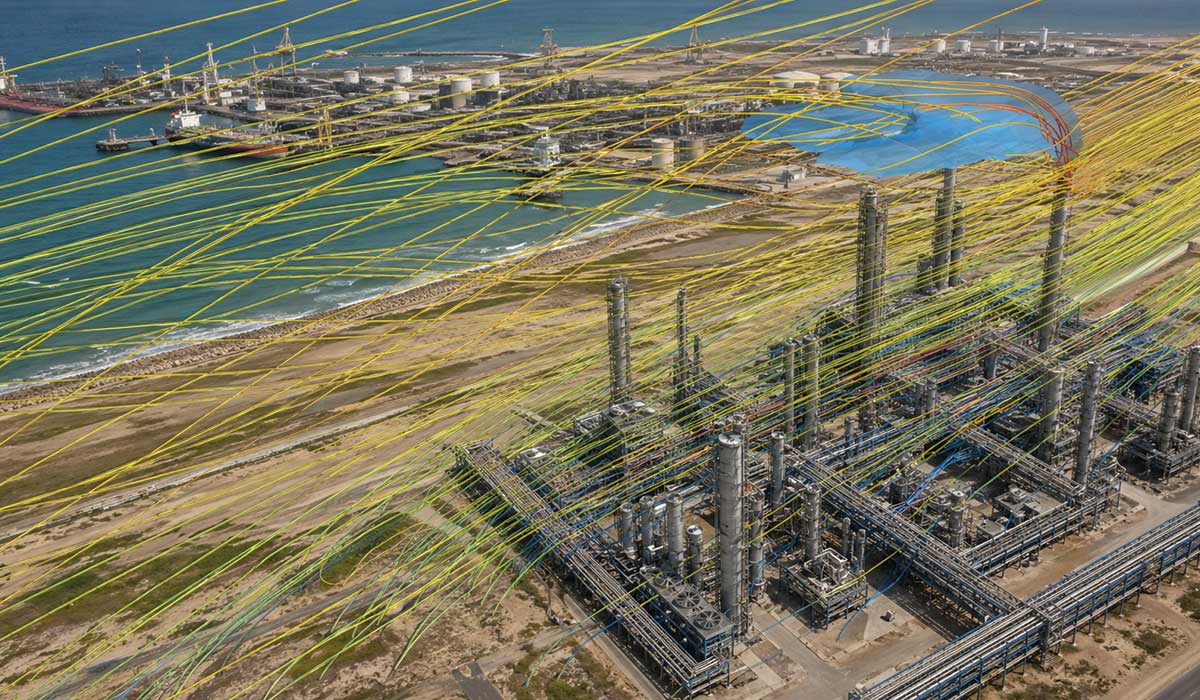
Some engineering questions can only be answered by modelling the underlying physics. MES combines Computational Fluid Dynamics, advanced simulation and bespoke physics-based methods to understand how hazards develop, systems perform and failures occur.
By representing the actual geometry, operating conditions and interacting physical phenomena, we address questions that empirical correlations and spreadsheet calculations cannot fully resolve. The result is safer design, clearer risk understanding, improved system performance and faster root-cause resolution across the asset lifecycle.
By representing the actual geometry, operating conditions and interacting physical phenomena, we address questions that empirical correlations and spreadsheet calculations cannot fully resolve. The result is safer design, clearer risk understanding, improved system performance and faster root-cause resolution across the asset lifecycle.
What we do
- Gas-release and dispersion modelling, including hydrogen, ammonia, methanol, LNG, CO₂, hydrocarbons and other toxic or flammable substances
- Fire, vapour-cloud and dust-cloud explosion modelling, including flame propagation, thermal radiation, blast and overpressure
- Natural and mechanical ventilation, confinement and gas-accumulation studies
- Flare, vent and exhaust modelling, including smoke movement, toxic-gas ingress and air-intake interaction
- BESS thermal-runaway, ventilation, gas-dispersion and fire-consequence modelling
- Offshore airflow, helideck turbulence, temperature and availability assessment
- Complex and multiphase release modelling, including flashing, pool spreading, evaporation, dissolution, deposition and sublimation
- Process-performance, flow-assurance and design-verification studies
- Pressure-surge and transient-flow assessment, including water hammer and gas blowby
- Performance and failure investigation, including erosion, flow-accelerated corrosion, thermal fatigue, flow-induced vibration and maldistribution
- Bespoke analytical and coupled modelling where standard software cannot represent the complete physical sequence
Beyond standard simulation
Not every engineering problem fits a standard software workflow. Where established tools cannot represent the complete physical sequence, MES develops bespoke analytical models, source terms and coupled modelling approaches.
Our modelling specialists work alongside our Process Safety and Asset Integrity teams, ensuring that results translate into practical decisions on design, safeguards, operability, integrity and risk.
Our modelling specialists work alongside our Process Safety and Asset Integrity teams, ensuring that results translate into practical decisions on design, safeguards, operability, integrity and risk.
Typical outcomes
- Answers, where simplified methods cannot adequately represent the physics
- Safer and more efficient design, layout and operating decisions
- Ventilation, detector placement and safety systems validated by modelling
- Calculated fire, explosion, thermal and structural design loads
- Improved process performance and better-targeted integrity activities
- Evidence-based root-cause findings that help prevent repeat failures
- Defensible technical evidence for high-consequence and ALARP decisions
- Reduced uncertainty without unnecessary conservatism


